Visit Japan without going to Tokyo and Kyoto at all
Your next trip to Japan beyond Tokyo and Kyoto awaits. Here are 14 destinations off the Golden Route you could consider for your second trip to Japan and beyond. Think of it as a “skip Tokyo Japan trip.”
We’ve visited Japan multiple times with kids, and since 2025 we’ve had our own place in Osaka. The first time we came home from Japan in 2013, we immediately wanted to go back. We bet you’ve had a similar feeling ever since you finished your first trip to Japan. But for future trips, you wonder where you’d go.
(In fact, as I write this, we’ve recently wrapped up a 2-night stay in Nara and a 3-night stay in Kyoto, plus we’re planning more trips, including road trips around Shikoku, rail journeys in eastern Japan, our first trip to Hiroshima, and a lot more.)
From Tokyo to Kyushu, our family of four has soaked in onsen in Beppu, visited all 10 One Piece statues in Kumamoto, fed deer in Nara, and marveled at Tokyo Disneyland. As much as we enjoy and cherish popular destinations like Tokyo and Kyoto, we totally understand when a repeat Japan visitor wants to get beyond those well-trodden and often overcrowded paths.
When you’re ready for more
The 14 destinations below can fire up your travel dreams. When you’re ready to go deeper and start making plans for your Japan trip beyond the Golden Route, check out our growing in-depth guides to other parts of Japan.
Here are 14 destinations worth going back to Japan for, and you don’t even have to go to Tokyo or Kyoto.
Osaka
Japan travel beyond Tokyo can be as easy as shifting your focus to Osaka.
The city’s energy is more laid-back than Tokyo’s, and once you get out of the main tourist hubs like Dotonbori and Shinsekai, the crowds thin out fast. We adore Osaka so much we bought a home here.
Osaka appeals to us because it balances Japan’s calm and quiet with a more outgoing, fun side of the culture. With Osaka’s history as a port and business hub, it makes sense: There’s a more outspoken side of Japan that comes alive here.

Most of our random conversations with people happen in Osaka. From the larger-than-life displays in Shinsekai to the intense focus on ubiquitous food (seriously: on many streets, you’d swear there are sizzling griddles everywhere), Osaka also brings together beauty, cultural depth, and history.
The city is more laidback than Tokyo—and since it’s smaller, Osaka is just that much easier to get around too.
Another perk of Osaka? You fly in and out of Kansai International Airport (KIX) instead of flying in and out of Tokyo.
Getting there
Fly into Osaka’s Kansai International Airport (KIX), or take the train, including Shinkansen high-speed trains, from Tokyo.
When flying, see if you can fly directly into Osaka. We’ve done this when flying in from Singapore. Or, on another visit when coming in from the USA, we cleared immigration and customs at Tokyo’s Haneda airport, then flew a domestic flight to Osaka.
Nagoya
Best known as the global home of Toyota, Nagoya also draws anime fans to its Ghibli theme park and history buffs to its castle. If your interests align, it can become a surprisingly absorbing place to spend a night or three. Tickets for Ghibli Park can sell out fast. Booking in advance is a must.
Reachable within a couple of hours of Osaka, Nagoya is a natural destination for a day trip or few nights. If you have just one or two things you want to do in Nagoya (such as a castle and automobile history indulgence), a day trip should suffice. If you have multiple activities in mind, and especially if you want to visit Ghibli Park and/or Legoland, plan 2-4 nights.
Getting there
You can start enjoying Nagoya within about an hour’s train ride east of Osaka. If coming from Tokyo, Nagoya is about 2.75 hours’ ride.
Nara
We’ve come to realize that as much as we appreciate Kyoto, we like Nara even more.
Japan’s first permanent capital makes one of the most logistically satisfying day trips in the country. Nara’s compactness means you can roll off the train at Kintetsu-Nara Station and be feeding deer within minutes. Todaiji Temple (home of Japan’s largest brass Buddha statue), the hilltop temple grounds of Kofukuji, and the deer at Nara Park are all walkable from the station.

Since so much is walkable, a Nara day trip means you can do a surprising amount of activities and sightseeing, for a full and satisfying day.
A day trip enhances your Japan trip, but personally, we prefer to stay a night or two in Nara. While the park and Todaiji Temple grounds can get pretty crowded during the day, once the day trip folks head back to Osaka and Kyoto, you get to enjoy a different, quieter side of the city. Having a nighttime wander around Sarusawa Pond and the Kofukuji Temple grounds is a highlight for us, especially when paired with dinner at a nearby restaurant and a soak back at our accommodation’s onsen.
Getting there
Nara is less than an hour’s train ride east of Osaka, and about 30-40 minutes south of Kyoto.
Wakayama
About an hour south of Osaka, Wakayama sits at a rare intersection: metro-adjacent but touches rural calm, with seaside accessible by train yet minutes from the city center. When you want a slower pace but still be close to urban amenities, Wakayama can make a great day trip from Osaka, or stay a few nights for max recharge and immersion.
The prefecture’s compact size packs in a range of destinations: forest hiking trails full of temples, intriguing towns and cities, and beaches that can be a respite from Japan’s notorious summer humidity.
Tops on our list: Wakayama Castle (especially with its dramatic mountaintop location), touring a soy sauce manufacturer (Wakayama is regarded as the origin of Japanese soy sauce), fresh tuna, and the pork and soy sauce broth of Wakayama ramen.
Getting there
From Osaka Station, it’s about an hour and a half train ride to Wakayama City.
Kobe
Yes, the beef is real and worth it, but Kobe’s story is bigger than its menu. The city’s comeback from a devastating 1995 earthquake is quietly remarkable. Baseball fans can find a pilgrimage to Hanshin Koshien Stadium worthwhile.
Another plus? Kobe is at the northern end of Osaka Bay, and some travelers find it more convenient to stay in this area for proximity to inter-city trains, including the Shinkansen via Shin-Kobe Station.
If your time in this area includes attractions at the northern end of Osaka as well as Himeji, Kobe can be an ideal base, since you’re bang in between both locations. The city has built back strong since the 1995 quake, and impressed us with its mix of quiet, look-out-for-each-other neighborhoods, with modern reconstruction and ease of getting around.
During our first trip to Japan in 2013, we stayed a couple of nights in Kobe to recharge. Our hosts told us how no one locked their doors, in case another quake made the doors too hard to open. When we walked around the neighborhood, we could often catch a glimpse of people tending to the local danjiri float, used in local parades and festivals.
Getting there
Kobe is on both regular and Shinkansen high-speed rail lines, making it easy to reach as part of the same train ride from Tokyo, Kyoto, or Osaka. From Osaka Station, you can typically be in Kobe within 20-40 minutes, depending on the train route. If you’re coming from Tokyo, it can worthwhile to take the Shinkansen high-speed train to Kobe, but usually it’s cheaper and about the same travel time to take a regular train from Kyoto or Osaka.
Himeji
Himeji Castle is one of the only original castles remaining in Japan, and the soaring white, graceful structure is as iconic as Mt. Fuji. While other castles are restorations or reconstructions, Himeji’s original structure deepens appreciation and makes a day trip here even more memorable.

Himeji is just west of Kobe. The castle is the minimum, but if time permits, the full castle grounds are a good wander, and there’s a zoo. This area can be a good sightseeing break when heading west toward Hiroshima or Kyushu too.
Getting there
Located west of Kobe, Himeji is about an hour train ride from Osaka via a regular train. Like Kobe, it’s also on the Shinkansen high-speed line. If you’re coming from Osaka or Kyoto, check the time and cost: Cheaper regular trains often take a similar travel time to the more expensive high-speed rail for this shorter ride.
Awaji Island
Connected to Kobe via the world’s longest suspension bridge, Awaji offers pebbled beaches and temple visits. In the strait between Awaji and Shikoku, the Naruto Whirlpools are said to have inspired the manga/anime character Naruto Uzumaki. Getting around requires a rental car or bike, but for a nature-centered detour, it delivers.
The island is home to a combo of quirky attractions. Awaji grows most of Japan’s onions, and onion-themed attractions abound, plus the island is home to the anime-themed Nijigen no Mori amusement park.
But along with nature, a major draw is the food, especially seafood, including the infamous fugu (or poisonous pufferfish), along with candied Naruto oranges and Awaji beef.
Getting there
Awaji Island, like Shikoku below, can take longer to get to than you might think when looking at it on a map. (For example, our Japan home is south of Sakai, we’ve been confounded that it can take about as long to go to Awaji, on the other side of Osaka Bay, as it can to go to Yamaguchi at the far western end of Honshu, the main island).
A train ride from Osaka to Awaji will typically take around 2.5-ish hours. Usually you hook around the top of Osaka Bay, pass through Kobe, and come to Awaji via the northern end of the island.
Shikoku
Japan’s smallest and least-visited main island is for travelers who genuinely want to get away from people. Shikoku offers rugged mountains, rural landscapes, a handful of cities for logistics, and Dogo Onsen Honkan, which many consider similar to the bathhouse in the classic anime film Spirited Away.
With rural green space, seaside, and open road, we’re planning a Shikoku road trip, probably tied in with some time on Awaji.
The draw of Shikoku lies in a sense of getting away from the crowds and bustle that define so many of the main tourist hubs in Japan. Yet you can still take part in distinctive parts of Shikoku culture, including Kagawa’s udon noodles, the original keep of Kochi Castle, and traditional Awa Dance.
Getting there
If you started from Awaji Island, visitors usually head west to enter Shikoku via Naruto on the eastern side of Japan’s smallest main island. You can also press on to Takamatsu on the northeastern edge, as it’s one of the main cities on Shikoku.
Visitors heading to Shikoku also often arrive when traveling from Okayama, just across the Seto Inland Sea. From Hiroshima, a ferry goes to Matsuyama on Shikoku’s western side.
Hiroshima
Yes, you come to Hiroshima in part of the history: Atomic Bomb Dome, Peace Memorial Park, Hiroshima Peace Memorial Museum. Really, you stay for the city that has rebuilt itself and is home to culture, food, and just good living.
For example, do not miss Hiroshima-style okonomiyaki: a layer of noodles beneath the egg and cabbage, with a crunch-chew that makes it a completely different dish from Osaka’s version.
Getting there
On regular and Shinkansen high-speed rail lines, Hiroshima is a straightforward destination from Tokyo, Kyoto, Osaka, or even Fukuoka. In fact, while Hiroshima is about 4 hours on the Shinkansen from Tokyo, it’s only about an hour and a half from Osaka and just over an hour from Fukuoka’s Hakata Station.
Okayama
Between Himeji and Hiroshima, Okayama is on the Shinkansen lines and doesn’t get nearly the attention it deserves.
Okayama is home to Korakuen Garden, one of Japan’s best landscape gardens. In contrast to the white walls of Himeji Castle’s keep, Okayama Castle is nicknamed Crow Castle for its black walls. The region is also famous for its grapes and peaches, woven into local folklore through the legend of Momotaro, the Peach Boy.
When we were looking for a home base in Japan, Okayama is one of the cities we considered and researched. We’ve also passed through on the Shinkansen while en route to Kyushu, and those wee glimpses continue to keep my curiosity piqued.
Getting there
Pretty much bang in between Osaka and Hiroshima, Okayama is only about 40–50 minutes’ train ride. Plus, the city is an easy waypoint when your route includes Shikoku. Okayama and the northern hub of Takamatsu are less than an hour apart by train.
Sea of Japan Coast (Tottori and Matsue)
Japan’s main cities and top visitor attractions are mostly along the Pacific and Seto Inland Sea sides of Japan. The northern and western coasts, along the Sea of Japan (or East Sea) are much less visited.
To be fair, it can be more challenging to get to destinations such as Tottori and Matsue. However, crossing the central mountains to the Sea of Japan side of Honshu will put you in places the foreign travelers rarely visit (we haven’t been there yet either, but they’ve got our attention).
Go in knowing that transportation is less convenient and English signage is limited, but the payoff is an immersion into a side of Japan most foreign visitors will never experience.
For example, Tottori is home to broad beaches and large dunes that remind us of the Oregon Coast, and the intricate art of the Sand Museum offers some of the world’s best sand sculpture. Considered a gathering place of the gods in Japanese mythology, Matsue immerses visitors in legend and history, plus you can steep yourself in hot springs and check out both Matsue Castle and Lake Shinji, one of Japan’s largest lakes.
Getting there
Cross from the southern to northern sides of Honshu can take longer than you might think. For example, heading to Tottori via train and bus from Osaka takes about 3 hours.
Matsue is farther west. Reachable in 3.5 hours to about 5 hours from Osaka, it can be easier to head here from Okayama or Hiroshima. Travel time is still around 2.5-3.5 hours, but routes can be more straightforward.
Yamaguchi
At the western edge of Honshu, Yamaguchi developed far from Japan’s political centers and built its own version of Kyoto’s culture, so much so that it earned the nickname “Kyoto of the West.” For travelers who love Kyoto but find the crowds a problem, this is worth a serious look.
Yamaguchi is high on our list for exactly this reason. While Kyoto is convenient from our base in Osaka, we aren’t fans of big crowds. Yamaguchi is on the Shinkansen lines, and its location about 30 minutes west of Hiroshima makes it a natural stop.
The main city can be a sightseeing break or a day trip, whether from Hiroshima or while en route to Fukuoka. Or, and this is what we’re looking into, rent a car for easier travel to massive limestone caves, hiking along hilltops, and a set of red torii gates at a north coastal headland that are similar in style to Kyoto’s iconic Fushimi Inari Shrine, but without the crowds.
Getting there
On regular and high-speed Shinkansen lines, Yamaguchi is at the western end of Honshu, but an easy train ride. It’ll take about 4.5 hours from Tokyo or 2 hours from Osaka, but less than an hour from Fukuoka.
When searching, keep an eye on the options in your mapping app. Yamaguchi is the city in Yamaguchi Prefecture, at the very western tip of Honshu. However, there’s another area named Yamaguchi both in Fukuoka Prefecture on Kyushu, and in Saitama Prefecture just outside of Tokyo.
Kyushu
Japan’s third-largest island is about the size of Maryland and holds more variety than most travelers expect: cool cities, prolific onsen (especially Beppu), active volcanoes you can visit and peer into the caldera, stunning autumn leaves, and Takachiho Gorge’s quiet beauty (and lovely riverside walks). Our family spent two months on Kyushu. We can’t wait to go back.
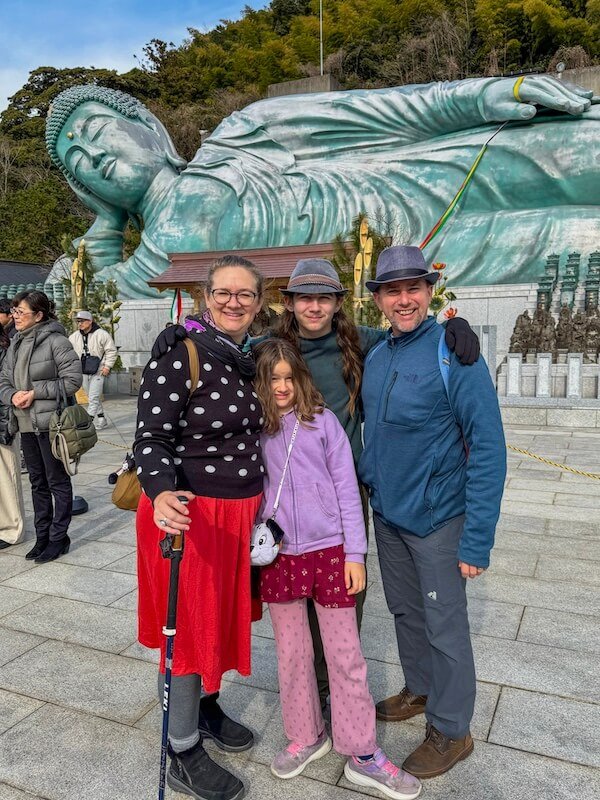
Fukuoka is the hub and biggest city. Kumamoto is the base for One Piece fans, as the prefecture is home to a statue of each Straw Hat Pirate. From its urban bamboo grove to the countless onsen, Beppu gives you both hillside nature and plenty of opportunities for a hot soak.
Learn more in our Kyushu guides to Fukuoka, Kumamoto, and Beppu
Getting there
From Tokyo (about 5 hours) or Osaka (about 2.5 hours), pretty much any Kyushu destination will involve you stopping at or going through Fukuoka’s Hakata Station. If visiting destinations on the eastern side of Kyushu, you might change at Kitakyushu, on the northern edge of Kyushu.
Okinawa
If your Japan trip needs warm water and a touch of the tropical, Okinawa is where you go.
Subtropical and distinct, Okinawa is technically Japan but culturally its own thing. With over 100 islands, Okinawa is far south of the mainland. You’ll find coral reefs, mangrove forests, and a history that pulls from Austronesian and Southeast Asian influences as much as from Tokyo.
A few highlights? Fire destroyed Shuri Castle in 2019, but the castle’s reconstruction is expected to be complete by fall 2026. Okinawa’s Churaumi Aquarium includes giant sea life such as whale sharks—making this a more distinctive aquarium experience than many. And pretty much any meal, dessert, or drink can take on extra zip from the shiquasa, a tart, lime-like local citrus fruit.
Getting there
Granted, Okinawa is about 2,100 km (1,300 miles) from Tokyo. Most visitors opt to fly from Tokyo, Osaka, or Fukuoka, to Okinawa’s Naha Airport (OKA). This is the easiest option, as one flight can have you right in Naha, Okinawa’s main city and jumping-off point for other parts of the islands.
Another option? From Kagoshima, the southernmost city on Kyushu, a day-long ferry ride can have you in Okinawa.
To enhance your travel experience, leave the Japan Golden Route
Western Japan destinations, islands to the south, and more: Beyond Tokyo and Kyoto, you can enjoy a range of Japanese cities, towns, and countryside. Plus, Japan off the Golden Route still gives you access to an international airport and a range of trains, along with all the dining, conveniences, and deep history that make Japan so special.

When you’ve visited Japan before and already checked out Tokyo and Kyoto, skipping them on your next Japan trip isn’t missing out. It’s trading up for something more personal, tailored to your own interests, and more tightly aligned with what you want out of your time in Japan.
Now you’re thinking about how your next trip to Japan could be deeper and more you. Ready to build the itinerary? Go deeper with our Japan guides.