Japan’s first permanent capital is beautiful, compact, approachable, and an easy day trip
A Nara day trip from Osaka or Kyoto deserves a spot on your Japan itinerary, especially when visiting with kids.
Located less than an hour outside of Kyoto and Osaka, the city of Nara was Japan’s first permanent capital city, before Kyoto and later Tokyo. Today, the city’s hills, streets, green spaces, and neighborhoods keep that history alive. Nara has gained renown not just for its culture and temples, but for its wild deer that people can feed in Nara Park.
Nara in one day is doable. With just one day, you’ll want to keep your itinerary focused, especially on a Nara day trip with kids. Let’s break down how an Osaka to Nara day trip, or a Kyoto to Nara day trip, can work for your travel plans.
Why Nara deserves a day trip in your Japan itinerary, especially when visiting with kids
Kyoto is beautiful, more formal, and perpetually overcrowded nowadays. Osaka is a major metro area, bold and such a joy, but a big city is still a big city.

Nara deserves a day trip in your Japan itinerary because:
- It’s a break from Kyoto’s crowds and from the sprawling Osaka metropolitan area.
- You can be in Nara in less than an hour from each city too, so you can still have a full day enjoying Nara, yet still only need about two hours of there-and-back travel time.
- The former capital’s compactness means that from Nara’s Kintetsu-Nara train station, you are close to the major attractions you’ll prioritize for your day trip.
- You can tie your day trip to just two major attractions, but easily have other things to see, do, and enjoy along the way
We love talking about Nara from our own experiences there. Our family of four has visited Nara twice so far, first as a day trip with other worldschooling families, and later as a two-night stay during the mid-August Obon festival. We’ve visited Nara with kids, and now with a tween and teen.
Everything we suggest is from our perspective as traveling parents who want to balance checking out the great things a destination like Nara offers, but without overwhelming and overtiring the family.
Use these helpful resources to plan and book your trip
Plan your trip to Nara
If you want to leave the logistics to someone else, you can also book a day trip tour to Nara.
When to arrive in Nara for a day trip?
We suggest arriving in Nara in the morning, arriving by 10 am if possible. You’ll have more of the day ahead, so you can account for delays, tweaks in your schedule, or times when you want to rest or linger at an attraction or activity.
Hint: Be flexible about feeding the Nara deer. Once vendors sell out of their deer crackers, they pack up and leave for the day. We’ve seen Nara Park empty of cracker vendors as early as noon.
How to get to Nara by train
From either Kyoto Station or Osaka’s Namba Station, you can easily arrive in Nara in less than an hour. The trip is just long enough to merit bringing a few snacks from the station to enjoy on the ride, but short enough that no one should be too restless by the time you arrive.
Kyoto to Nara
When visiting from Kyoto, your most common way to get to Nara is via regular (not high-speed) trains departing from Kyoto Station.
Another option is the Aoniyoshi scenic train, which leaves from Kintestu-Tambabashi Station. The view when leaving from Osaka is more scenic, honestly. From Kyoto, a lot of the route is more developed and urban, and less green, natural space.
Osaka to Nara
Osaka-Namba Station is your hub for getting to Nara. Fortunately, Namba is also one of Osaka’s chief rail hubs. Getting there from where you’re staying is usually easy to figure out. Also see if you can catch the train from another station along the line, though some services might be local or limited express trains that will make more stops.
If leaving from Namba Station, it’s easy to stock up on train treats or have some snacks before you get on board.
Hint: Instead of Nara Station on the JR Nara Line, we suggest arriving at Kintetsu-Nara Station via the Kintetsu Line (or Kintetsu Railway). From here, the East Exit puts you right at the far western edge of Nara Park.
When you arrive at Kintetsu-Nara Station
Head for the east exit (higashiguchi). Along the way, you can get a stamp from the visitor center just outside the escalator at the exit. Plus, there’s a fountain that’s a common (and often crowded) spot for photos.
Just across from the exit, the Lawson Station convenience store is handy for any quick stops for snacks or drinks, especially if you’re visiting during Japan’s notorious hot, stuffy summers. Lots of people will be shopping there, but the store is set up to manage the flow well. Stopping there usually only takes around 5-10 minutes, depending on the line.
Once you leave the station, you are ready to get going on why you took a day trip to Nara.
Your Nara day trip has 2 priorities. Here’s what they are.
Nara’s compact size and the natural constraints of a day trip mean you want to be strategic about your itinerary, especially when visiting with kids. You won’t see it all or do it all. That’s okay. You’ll do the 2 main things that are the main reasons to visit Nara:
- Feed the deer while exploring Nara Park
- Visiting the giant bronze Buddha statue in Todaiji temple, which is also one of the largest temples (and largest Buddha statues) in Japan
Feeding the deer in Nara Park
Looking into a visit to Nara means you’ve heard about the deer. Legend says that the deer were messengers to the nearby gods who lived in the forest and hills. Another myth says that a god rode a white deer into the city.
Today, Nara’s deer are wild but legally protected. They live in the protected forest around the city, but the deer like to commute into the city during the day.

When people come to Nara, one thing they love to do is feed the deer, or “shika” (鹿) in Japanese.
However, that doesn’t mean feeding them anything you want. Many deer get sick every year because people feed them things they shouldn’t. As much as we wish that was some rhetorical nannyish thing to say, it isn’t. On our most recent trip to Nara, we saw someone feed a deer a tissue.
That’s right. A tissue.
Please don’t feed the deer human food. Or personal hygiene products. Or anything else other than…
Only feed deer crackers, or shika senbei, to the deer
Local rules and customs dictate that visitors can only feed the deer from packs of approved shika senbei (鹿煎餅, which translates to “deer biscuits” or “deer crackers”). Packs of these were ¥200 when we visited (subject to change, of course), or about US$1.29.
The crackers are made from a special recipe. Even the rice paper packaging is made to be safe for the deer to eat. And again: please, please, don’t feed the deer anything else.
Hint: The deer are still adorable whether or not you’re feeding them. Even if you aren’t able to get crackers, you can get photos and videos.
Getting to Nara Park
From the station, head east toward Nara Park. This area has some hilly spots, but the park’s green space has many paved and natural paths, plus a paved sidewalk surrounds the park perimeter.
Vendors throughout the park area sell the crackers. Once you buy yours, move at least a hundred yards/meters away from the stalls. Otherwise, the stalls get jammed up with a chaos of deer and visitors.
We often prefer going into the park’s green space itself to find deer to feed. Naturally, feeding the deer is a great chance to get photos and videos too. Keep an eye on the kids; the deer are usually pretty calm, but they can get pushy.
Visiting the giant Buddha statue at Todaiji Temple
Your second major priority for Nara? Finding yourself in awe.
Moving east along Nara Park while you feed and enjoy the green space offers a bonus: You’re already on the way toward Todaiji.

Not only is the temple one of the world’s largest wooden structures. It’s home to all 16 meters (52 feet) of the temple’s giant bronze Buddha statue.
Getting to the temple
It’s about 1.6 km, or one mile, from Kintetsu-Nara Station to the entrance of the Great Buddha Hall of the Todaiji complex. You’ve already covered some of that distance, just by leaving the station and going along the park.
Much of this path has at least some upward slope. It’s a lovely walk, but consider a bus or taxi if you or your family need to preserve walking energy.
You’ll follow the path along the northern edge of Nara Park, so the park is to your right. You’ll also get glimpses of the park’s cultural attractions, such as the Nara National Museum. Some of those can be priorities for a future Nara trip (we’ve visited twice and haven’t made it to them yet). They don’t need to be on today’s itinerary, especially if visiting Nara with kids.
Just past a small pond across the street, you’ll turn left and follow the road up and around to rejoin the park space just south of the broad, two-tiered Nandaimon Gate. Pass through the gate and keep heading north. There’ll also be a ticket counter and entry gate.
Inside Todaiji
No video, no social post, no image does justice to the Nandaimon Gate, the sheer mass of Todaiji, or the larger-than-life expanse of the Buddha statue inside the temple.
If anything, we found ourselves grateful for the small details, the cherry trees, and the temple buildings. They brought our perspective back to earth and helped us readjust before taking in the awe of the next sight.
Part of what makes Todaiji worthwhile? There’s a lovely walk and an impressive statue, yes. But other statues, carvings, art, and placards add detail, richness, and depth. Once inside the temple, a circuit takes you around the statue, so you can take in not only the statue from other angles but gain more understanding of the temple, its history, and its place in Japanese culture.
Around the temple area
As you get close to the Nandaimon Gate, keep an eye out for refreshment stalls. Mochi treats, drinks, and more are an easy break so you can rest a bit before taking in the temple and statue.
After Todaiji, you can follow the path back out to a row of shops and stalls with souvenirs and refreshments. To the left, a stretch of park greenery usually has more deer roaming around.
What else could be part of a Nara day trip, but is optional?
The joy of visiting Nara is that so many cultural icons are in one compact area. That’s also its own challenge, since it quickly becomes tempting to pack a bunch of temples, museums, deer feedings, and other attractions into a naturally compressed day.
If time and energy allow, here are some other attractions worth considering. Remember, though: Your top two priorities are the deer and the temple. If you don’t get to any of these, it’s okay.
Yoshikien Garden and Isuien Koen
Tucked into the urban space you pass by on the way to the Nandaimon Gate, the classical Japanese garden offers extensive, serene grounds throughout Yoshikien Garden. Along the northeast expanse of the garden, Isuien Koen (Back Garden) offers paths, ponds, teahouses, and a small Shinto shrine.

On the way to Todaiji or after your temple visit, consider detouring through the garden. If you have time for only one, it’s a toss-up: Yoshikien Garden is for foreign tourists (you’ll need to show your passport or foreign ID).
Isuien Koen’s admission fee includes entry to the nearby on-site (and quite worthwhile) museum. However, with its ponds, paths, greenery, and teahouses, Isuien Garden is a smaller style designed for walking around. It can be more approachable for families as a short, relaxing break from other sightseeing.
One museum
On your way back from Todaiji, especially after a rest and a meal, consider checking out one museum along the way in Nara Park. While there are many museums and cultural centers, we’d suggest focusing on some exhibitions in these, especially when visiting Nara with kids:
Todai-ji Museum: Since you’re already at the temple grounds, this museum is right there. Exhibits across five galleries give context to Todaiji, deepen your understanding of a history that goes back over 1,200 years, and showcase paintings, sutras, decorative art, and more related to the temple.
Okumura Commemorative Museum: Nature and tech combine in a space devoted to showcasing seismic protection tech.
Nara National Museum Complex: Along with the main museum, other buildings feature Buddha sculptures and ritual bronzes. We suggest picking just one building, checking out what sounds intriguing to you and your group, then assessing if you want to check out any of the other spaces.
Kofukuji Temple Complex
Set on top of a flattened hill, the pagodas and temples of Kofukuji are a distinctive and popular attraction to visit when in Nara. We love the serenity here, and it’s still on the way back toward the train station.

Stroll around Sarusawa Pond
Just down the stairs at the southern end of Kofukuji, Sarusawa Pond is one of our favorite spots for a touch of calm and the potential for a few more deer. The pond has a perimeter circuit that makes a lovely walk, especially with kids. Deer are usually around here during the day too.
Watch mochi pounding and snack on fresh mochi treats at Nakatanidou
From the northwest corner of Sarusawa Pond, follow along the left side of the street to the mochi-pounding Nakatanidou. While researching Nara, you’ve probably already seen it all over social media. The pounding happens only a few times a day, but the fresh mochi treats are delicious and available throughout business hours. They’re gooey, nutty, and so, so worth it.
Wander to the station via Higashimuki Shopping Street
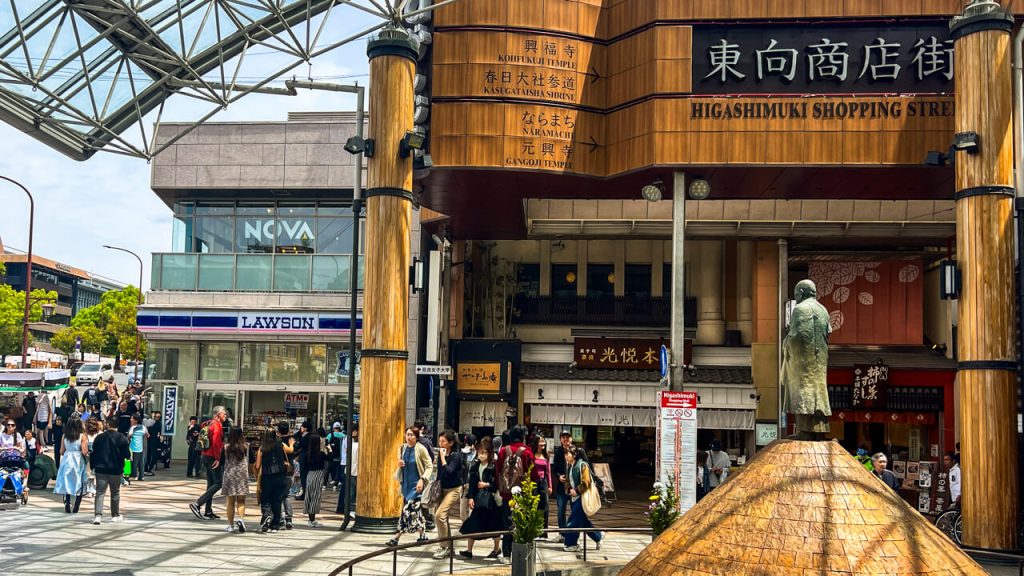
From Nakatanidou, cross the street and head up the covered Higashimuki Shopping Street. At the least, the window-shopping is spectacular. But souvenir shops, cafes, and restaurants abound. You can follow this street straight back up to the train station.
What we would pick for our own family
After feeding the deer, exploring Todaiji, and walking around, we would skip the museums and Yoshikien Garden. However—and as you likely already noticed—Kofukuji, Sarusawa Pond, Nakatanidou, and Higashimuki Shopping Street form a natural loop on the way back to the train station.

For our own family, we would pick walking south through Nara Park to pick up the temples and walk this loop. It’s a lovely taste of Nara (literally, because we always stop for mochi). And like any good day trip, it strikes that excellent balance of enough to be satisfied yet wanting to come back.
What to skip on a day trip to Nara, especially with kids?
Nara has so many wonderful attractions, and the city comes with the bonus of its key points of interest being pretty close together. However, on a day trip to Nara, especially with kids, you just cannot do it all. Here’s what we would suggest skipping on a day trip (but have in consideration if you’re staying at least one night):
- Museums: Yes, we mentioned them as an option because of their proximity to your route. But with younger kids, or if you’re just not as interested in the history, it’s okay to skip them.
- Naramachi Karakuri Toy Museum: We’ve visited Nara’s toy museum and adore it. But it’s out of the way for a day trip.
- Classes: You can take some pretty cool classes in Nara (such as a pottery class that we enjoyed one afternoon). However, you can take classes throughout Japan, but only Nara has the iconic deer and the amazing structures of the Todaiji temple and the Giant Buddha statue.
- Going deeper into Nara Park: When you look at the park on a map, you realize right away that Nara Park is huge. More shrines, gardens, and scenic sites await, such as the iconic Kasuga Taisha complex with its thousands of lanterns. But they are far better suited for a longer itinerary than a Nara day trip.
- Heading into Nara Prefecture: The city is just one part of a deeply beautiful, hilly area full of scenic nature. But if that’s a priority for you, so is staying at least a couple of nights in Nara.
How could seasonal factors affect my planning?
Nara definitely has seasonal considerations for both weather and crowds:
- Spring (March–June) includes cherry blossom season and the Japanese holiday period known as Golden Week. Spring is also the most popular time of year for Japanese and foreign visitors alike to come to Nara. Weather can range from mild to chilly.
- Summer (July–September) will also have crowded periods, especially around the mid-August 2-day Obon Festival, and because summer is simply when many folks can take vacation. It will be hot, and being in the hills offers little relief. Summer can also be rainy, with sudden cloudbursts, such as we experienced walking to our ryokan during our August visit.
- Fall (October–December) has some crowded periods, but the fall leaves and weather alike are typically lovely.
- Winter (December–February) is low season. Can get pretty nippy and sometimes snowy. Some attractions may be closed or have limited hours, but there will be far fewer visitors overall.
What could a Nara day trip itinerary look like?
Here’s a snapshot of what a Nara day trip itinerary could look like:
- Arrive at Kintetsu-Nara Station: Take around 30 minutes to freshen up, get through the station, snag a freebie stamp, and snag snacks/refreshments at the convenience store
- Feed the deer while wandering Nara Park: Could be minutes if you want to feed deer and cruise on through, or up to an hour, depending on how much park time you want. If bringing a picnic, possibly up to an hour and a half.
- Nara Park to Todaiji Temple: Around 30 minutes to stroll or roll. Or, save energy and take a bus to Todaiji Temple (buses can be crowded, but they’re affordable and worth it, especially when going uphill)
- Todaiji Temple: At least 2 hours. Every attraction here has some ground to cover in between. Linger at the Nandaimon Gate for photos and a rest. Figure at least an hour inside Todaiji. After all, this is the key feature of the day.
- Snack or meal: 30-60 minutes.
- Optional sights: If you take the optional loop above from Kofukuji to Kintetsu-Nara Station via Higashimuki Shopping Street, it’s about 2.4 km (1.5 miles) if starting from Todaiji Temple. You can through-walk it in about 35-40 minutes, so figure about 2 hours total for taking your time, appreciating attractions, and having the occasional rest, romp, or snack.
Either way, you finish back at Kintetsu-Nara Station, ready to board the train back to Kyoto or Osaka, and full of tasty treats and lovely memories.
Enjoy a wonderful day trip to Nara
Our family has visited Nara multiple times, including day trips and overnight stays. We’ve loved every moment of being there, appreciate that we’ve had the chance to visit, yet still can’t wait to visit again. Seriously: After a recent two-night stay, I told Jodie that as far as I’m concerned, every visit to Japan can include time in Nara.
With a focus on two principal attractions—feeding the deer and visiting Todaiji Temple—your own Nara day trip from Osaka or Kyoto can be just as memorable for you and everyone else you’re traveling with.